






Meet the AXIS C17 Series: Smarter Public Address for the Modern Network
In environments like schools, hospitals, transit hubs and commercial buildings, communicating clearly and reliably is not a nice to have, it’s essential. You need announcements, alerts, background music, schedule signals, sometimes emergency instructions. Traditional PA (public address) systems, with separate speakers, cabling, displays, strobes, etc., are often complex, expensive to install, and inflexible.
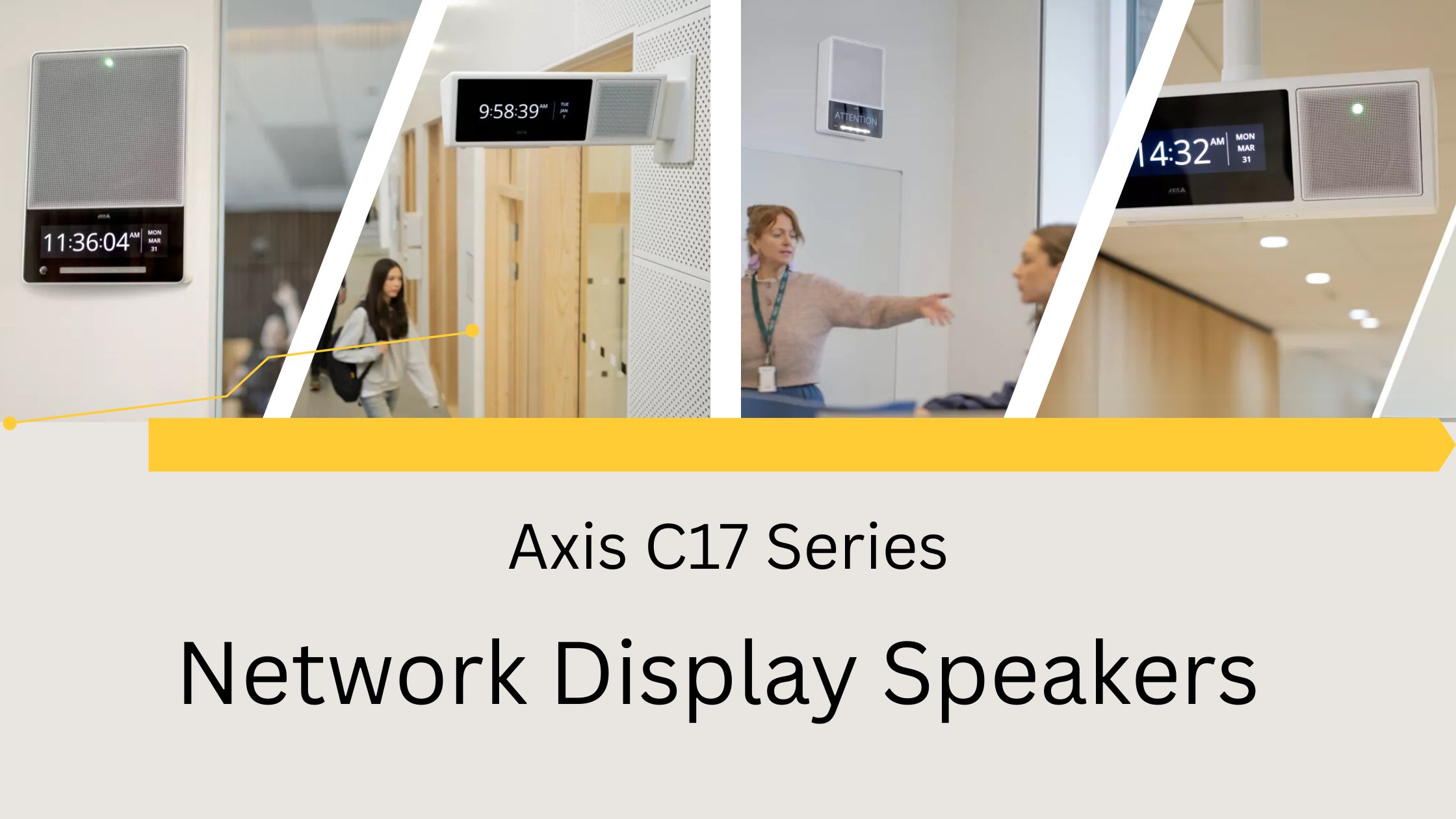
Enter the AXIS C17 Series: a family of network display speakers that bring together audio, visual display, strobe alerting, and smart software into integrated devices. The AXIS C1710 and AXIS C1720, aim to simplify installation, improve functionality, and provide flexible tools for both live and scheduled communication. Here’s a deep dive into what they offer, how they differ, and where they might make the biggest impact.
What is the AXIS C17 Series?
The C17 Series from Axis is a set of 3-in-1 public address devices for indoor use. The “3-in-1” refers to:
-
Speaker for live announcements, prerecorded messages, alarms, background music.
-
Display for textual messages, time/date, etc.
-
Strobe visual alerting to attract attention (especially useful when audio alone may not suffice).
These devices are not simply audio speakers with attached displays. They are network-enabled, PoE powered, software managed, and built to integrate with Axis’s audio management tools or third-party systems (including mass notification, video management systems).
Key features across the series include:
-
Two-way audio (full duplex, with echo cancellation), so operators can interact in real time.
-
Digital Signal Processing to ensure clear sound.
-
Remote health monitoring & testing to verify the device is functioning.
-
Content prioritization: urgent messages can override scheduled or background content.
-
Automatic brightness adjustment of display text depending on ambient light.
-
Motion detector sensors for triggered announcements.
The C17 devices are designed to reduce the need for extra equipment. Less cabling, fewer separate panels, fewer stand-alone displays, making installations easier and cleaner.
AXIS C1710 vs C1720: What Are the Differences?
While they share many core features, the C1710 and C1720 are tailored for different use cases and physical layouts. Here’s a breakdown of how they compare.
|
Feature |
AXIS C1710 |
AXIS C1720 |
|---|---|---|
|
Form factor / mounting |
Wall-mounted 3-in-1 speaker + display + strobe. Uses a wall bracket supplied to facilitate safer, easier mounting. |
Dual-sided version, usable on walls or ceilings (with accessory mounts: AXIS TC1604 Wall Mount or AXIS TC1605 Ceiling Mount) so as to address both sides (e.g. in corridors) with displays and speakers on both faces. |
|
Displays and speakers |
Single display + single speaker. Text display that adjusts for ambient light, strobe bar, etc. |
Dual displays + dual speakers (one face each), dual text output. Same kind of strobe bar integrated. More coverage in spaces where people come from / go to both sides of the device. |
|
Use-case suitability |
Ideal for open spaces, large rooms, auditoriums, areas where one face is sufficient to address audience. Also useful in halls with walls. |
Better suited for corridors, walkways, areas where traffic is on two sides, or ceiling mount applications. A single unit can serve more directions. |
|
Mounting accessories |
Comes with a wall-mount bracket included. |
Needs the accessory mounts (wall or ceiling) for non-wall applications. |
Key Capabilities in Practice
To understand how powerful and flexible these devices are, it’s worth exploring what they can do in real world deployments.
Live and Scheduled Messaging
These speakers support both live announcements and pre-recorded/scheduled messages. For instance, in schools, the morning bell, class change signals, or emergency messages can all be automated. Meanwhile, live override allows urgent messages to cut through.
Visual Messaging + Strobes
Text displays provide an alternative channel: useful in noisy environments, for people with hearing impairments, or when audio alone isn’t safe or sufficient. The adjustable text brightness helps ensure readability in various lighting conditions. The strobe adds visual alerting for high urgency events (alarms, emergencies).
Two-Way Audio & Response
Because the units support two-way audio, operators can respond to situations, get feedback, or conduct intercom-style communication. This could be helpful in security, customer service, or emergency response.
Integration & Software Control
The devices work best when managed through Axis’s audio management software (Audio Manager Edge / Pro / Center), which allows you to control schedules, zoning (which speaker speaks when), content prioritization, etc. Use with a video management system (VMS) or mass notification system is also supported.
Plus, remote testing and health monitoring mean you can know ahead of time when something may fail (e.g. speaker element, display, network). For mission-critical environments, that’s a big plus.
Where These Shine: Use Cases
Here are some environments and scenarios that are particularly well matched to the features of the C1710 / C1720.
-
Corridors/Atria in large buildings: The dual-faced design of the C1720 allows one unit to address both sides of a hallway, reducing number of units needed.
-
Educational institutions: Bell signals, class change, emergency lockdown messages, plus everyday announcements. Display helps in noisy situations or when audio may be missed.
-
Healthcare facilities: Clear messages, sometimes quietly delivered, but also alerts in emergencies; display helps for patients with hearing difficulties; strobe for urgent calls.
-
Transit hubs / stations: Busy ambient noise, mixed crowd; need for clear safety messages, visual cues, and scheduled announcements; ability to override schedules in emergencies.
-
Commercial or retail spaces: For background music, marketing or safety messages, and also for display of promotions or attention messages.
Things to Keep in Mind / Trade-offs
Here are some considerations when deciding whether C1710 or C1720 is right, or whether another solution is needed.
-
Coverage vs cost: Dual-faced displays (C1720) inherently cost more and may draw more power; if only one side needs coverage, a C1710 may suffice.
-
Ambient noise levels: In very noisy areas, even powerful speakers may struggle; acoustic design (placement, reflective surfaces) still matters.
-
Display readability: While automatic brightness helps, extreme lighting (e.g. direct sunlight, glare) may reduce readability. Also, font size, contrast, and viewing angle need to be considered.
-
Strobe considerations: For some users, strobes (flashing lights) can cause issues (health, distraction, regulatory). Configuring patterns, colors, speed, or disabling for certain alerts may be necessary.
-
Network requirements: These are IP-networked devices. Proper network design (bandwidth, latency, PoE capacity, VLAN / QoS for priority messaging) is important, particularly in large installations.
Conclusion
The AXIS C17 Series are well-designed network display speakers that marry multiple communication modalities into single units. In environments where clear communication, safety, flexibility, and ease of installation matter, they offer a powerful alternative to more traditional, component-based PA systems. If you’re planning a public address / mass notification / crisis communication system (or updating an existing one), considering these devices could reduce complexity, lower installation cost, and give more options for dynamic messages.

 USD $
USD $  CAD $
CAD $