






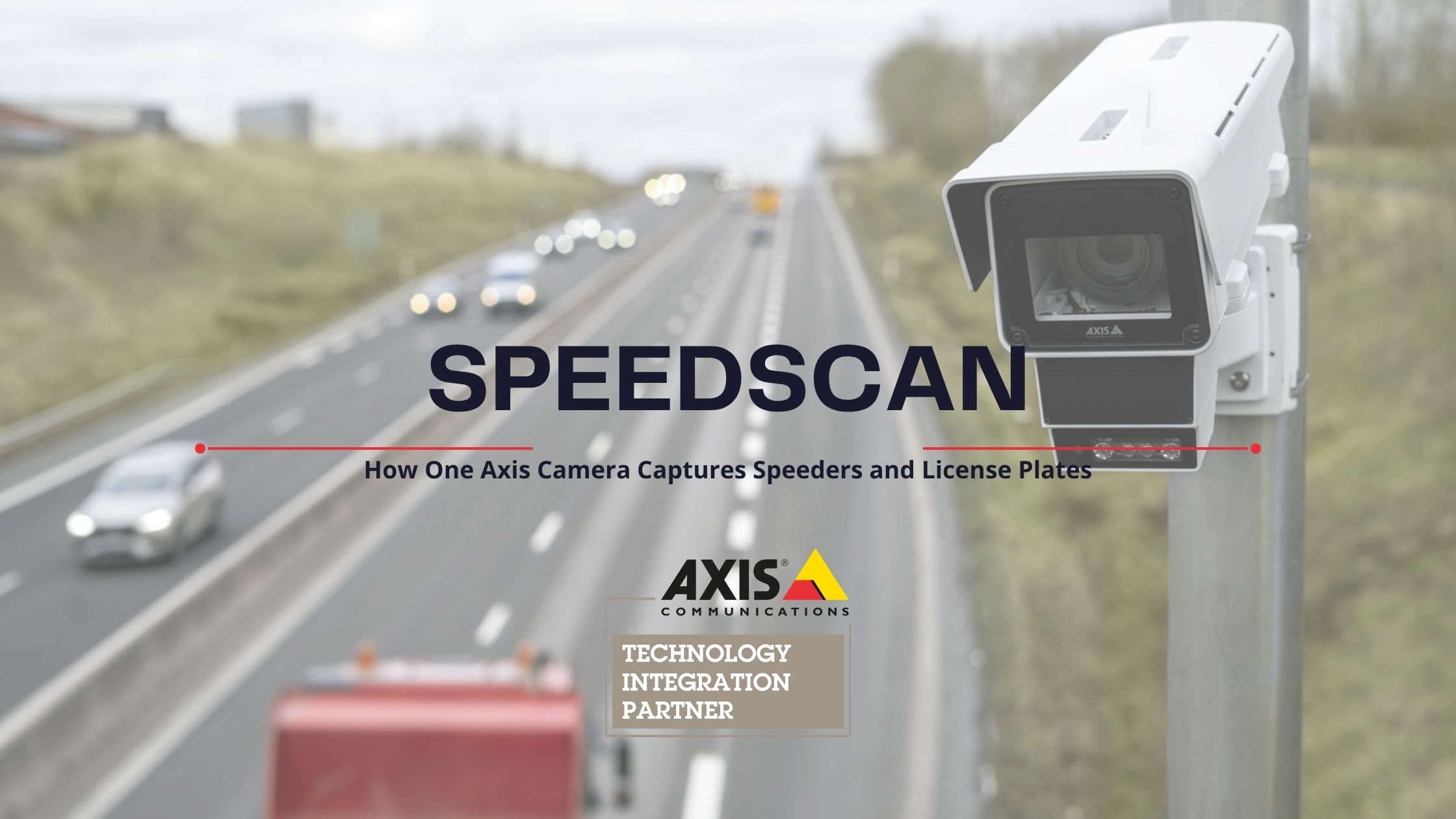
SpeedScan: How One Axis Camera Captures Speeders and License Plates – No Server Required
Every property manager has heard the complaint: “Cars are flying down our road.” And every security integrator knows what comes next – the awkward conversation about what it actually takes to prove it. Radar speed signs flash at drivers but record nothing useful. Traffic-enforcement systems identify vehicles but arrive with server racks, software platforms, and six-figure budgets. For a gated community, a corporate campus, or a logistics yard, neither answer fits.
There’s now a third option: a single camera that measures speed, reads the plate, and keeps its own records. Below is how the pieces come together : the radar, the plate reader, and SpeedScan, the on-camera application CamCentral developed to turn them into a complete speed-evidence system.
The hardware: radar and video in one housing
The AXIS Q1686-DLE Radar-Video Fusion Camera pairs a 4 MP video camera with a built-in 60 GHz radar covering the same field of view, factory-calibrated so the two stay perfectly aligned. The radar measures how fast every vehicle is moving – up to 200 km/h (125 mph), day or night, in rain or snow, while the imaging side, with traffic-optimized IR illumination, captures plate-readable detail even in complete darkness. Fusing the two means the camera doesn’t just detect “something moving at 47 km/h”; it knows which vehicle is moving at 47 km/h.
That solves half the problem. Speed without identity is just a statistic.
The identity: license plate verification on the camera
AXIS License Plate Verifier runs directly on the camera and reads plates as vehicles pass — no separate ALPR server, no per-read cloud fees. On its own it’s built for access control and vehicle logging. Combined with the radar, the camera now knows the vehicle’s speed, direction of travel, and plate at the same moment.
The missing piece: SpeedScan
Out of the box, the speed measurement and the plate read are separate data points. SpeedScan, a custom application CamCentral developed on the AXIS Camera Application Platform (ACAP), runs onboard the camera and fuses them into a single record:
- Continuous capture: every vehicle event is logged with timestamp, license plate, speed, and direction (approaching or departing).
- Onboard storage: records are written to the camera’s SD card. No server, no NVR dependency, no cloud subscription.
- Built-in dashboard: open the camera’s web page, set a speed threshold, and see only the vehicles exceeding it.
- One-click export: download the filtered log as CSV or JSON for reports, HOA meetings, or further analysis.
- Set-and-forget operation: the application restarts automatically with the camera and keeps logging unattended.
Installation is a mount, power, and a network connection for initial setup. The entire speed-evidence system lives in one device.
Field-proven: an off-grid campus deployment
SpeedScan wasn’t built as a lab exercise. It was developed for a university rolling out speed monitoring across its campus. The complication: the locations that most needed coverage had no power and no network connectivity.
The power answer was solar trailers – each camera rides on a self-powered, repositionable platform that goes wherever traffic patterns demand. The connectivity answer is the architecture itself: every record is written to the camera’s SD card the moment it’s captured. Where a link is available, entries stream back to the university’s central ticketing system; where there’s no link at all, staff retrieve the records directly from the SD card. Either way, a weak or absent network never costs a detection.
Why running at the edge matters
Cost. No server hardware, VMS licenses, or recurring analytics fees. The intelligence you already paid for in the camera does the work.
Resilience. Records land on local storage first, so a flaky uplink — or none at all — doesn’t create gaps in the evidence.
Privacy. Plate data never leaves the device until someone with viewer credentials exports it. For sites cautious about where vehicle data flows, that’s a meaningful control.
Simplicity. One device to install, one web page to check. When the question is “who has been speeding through here this month?”, the answer is a two-minute export — not a video review session.
Where it fits
- University and school campuses — campus-wide speed monitoring, even at locations with no fixed power or network.
- Gated communities and HOAs — document repeat speeders before escalating to towing policies or speed bumps.
- Corporate campuses and business parks — enforce site speed limits with data instead of anecdotes.
- Logistics yards and industrial sites — hold carriers and contractors accountable to safety rules.
- Parking facilities — identify vehicles treating the ramp like a runway.
- School zones and private roads — gather the evidence that justifies traffic-calming investment.
What it isn’t
A note on expectations: SpeedScan is a monitoring and evidence-gathering tool, not a law-enforcement citation system. Radar accuracy depends on correct mounting and periodic recalibration, and issuing fines from speed measurements is a regulated activity in most jurisdictions. Likewise, license plate data is personal information in many provinces and states. Deployments should follow applicable privacy law on retention and access. We design every installation with those constraints in view.
Built by CamCentral, an Axis Technology Integration Partner
SpeedScan is an example of what becomes possible when the camera is treated as a platform rather than a sensor. As an Axis Technology Integration Partner, CamCentral develops custom ACAP applications that run inside Axis devices, fusing radar, analytics, audio, and I/O into solutions that solve one specific operational problem well.
Have a vehicle, safety, or site-monitoring problem that off-the-shelf software doesn’t quite solve? See our technology integration services or talk to us. The answer may already be waiting inside a camera.
Update (July 2026): SpeedScan is now officially listed in the AXIS Technology Partner Finder. For the product overview, see our SpeedScan page.

 USD $
USD $  CAD $
CAD $