






Fisheye vs Multi-Sensor Panoramic Cameras: How to Cover More While Installing Less
Of everything on our store, panoramic cameras are what visitors have been researching most intensely these past weeks — fisheyes, multi-sensor domes, and everything promising the same thing: see more with fewer cameras. It’s the fastest-growing segment in video surveillance for a simple reason: the economics are unbeatable when you deploy the right type in the right place. The catch is that “panoramic” covers two very different technologies, and choosing the wrong one is the most common mistake we help customers undo.
The math that’s driving the boom
Replacing four fixed cameras with one panoramic unit doesn’t just save you three cameras. It saves:
- Three cable pulls — often the single biggest line item on an install, especially across finished ceilings or parking lots
- Three mounts, three conduit runs, three PoE ports
- Up to three VMS licenses — most video management systems license per IP connection, so one multi-sensor camera with four heads frequently consumes a single license (check your VMS’s policy — some license per channel)
- Three future service visits — every camera you don’t install is one you never maintain
That’s why a panoramic camera that costs twice as much as a fixed dome routinely comes out far cheaper as an installed system.
Fisheye: one lens, complete 360°
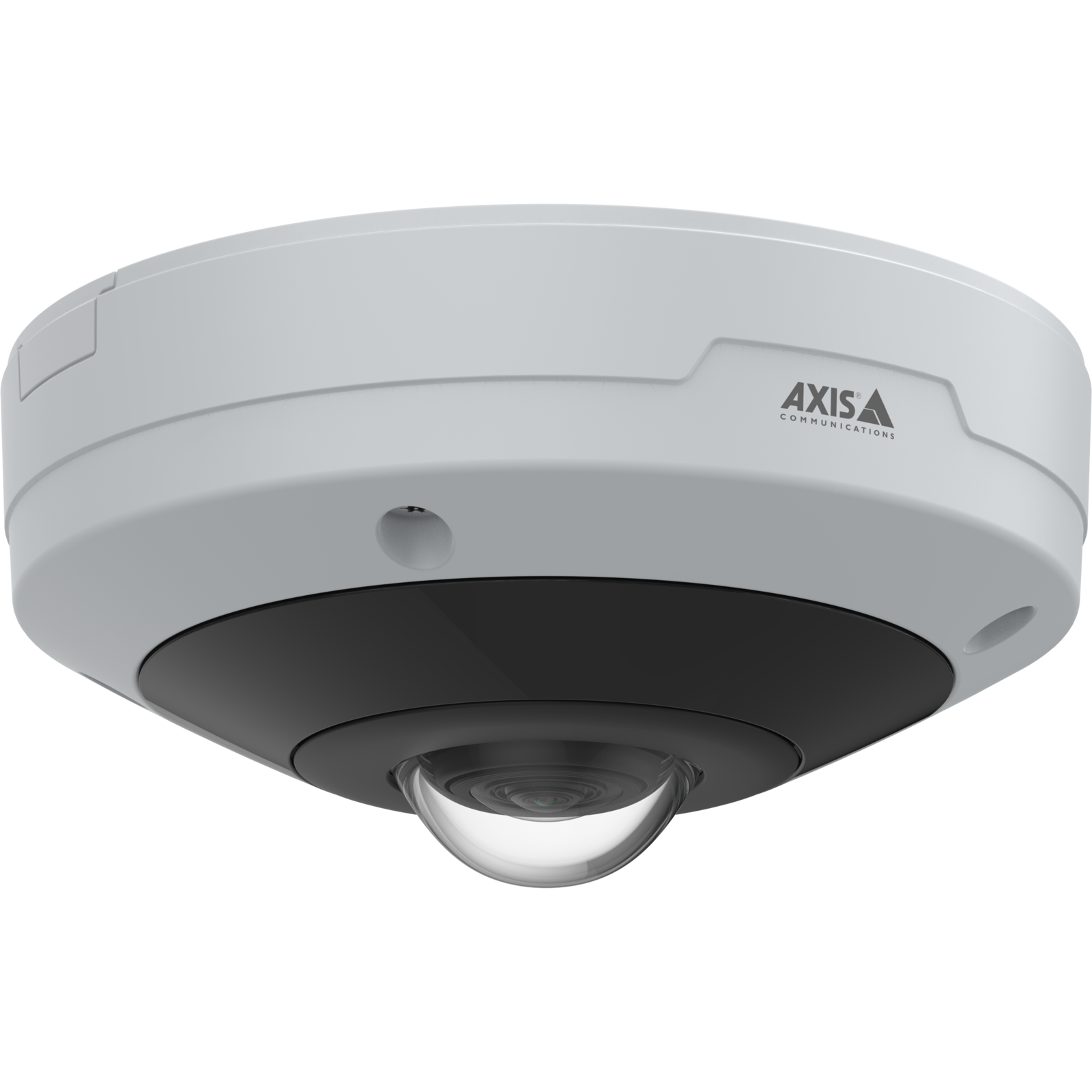
A fisheye camera uses a single ultra-wide lens and one large sensor to capture a full 360° image below its mounting point. Software dewarping — in the camera or in your VMS — flattens that circular image into usable panoramic or quad views, and lets operators digitally pan, tilt and zoom through recorded footage after the fact. That last part matters: with a fisheye, you can investigate an incident anywhere in the room even if nobody was watching that direction live.
Fisheyes shine mounted centrally on a ceiling in open interiors — retail floors, lobbies, classrooms, restaurants, elevators. One AXIS M4338-PLVE on a 3–4 m ceiling covers what would otherwise take three or four fixed domes. Their limit is pixel density at distance: past roughly 10–15 m, detail thins out, because those pixels are spread across the entire hemisphere.
Multi-sensor: four cameras in one housing
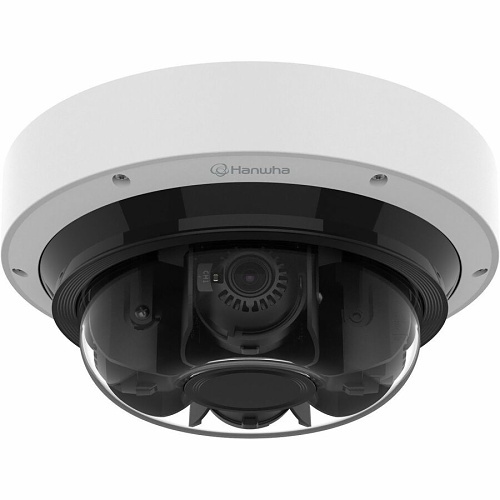
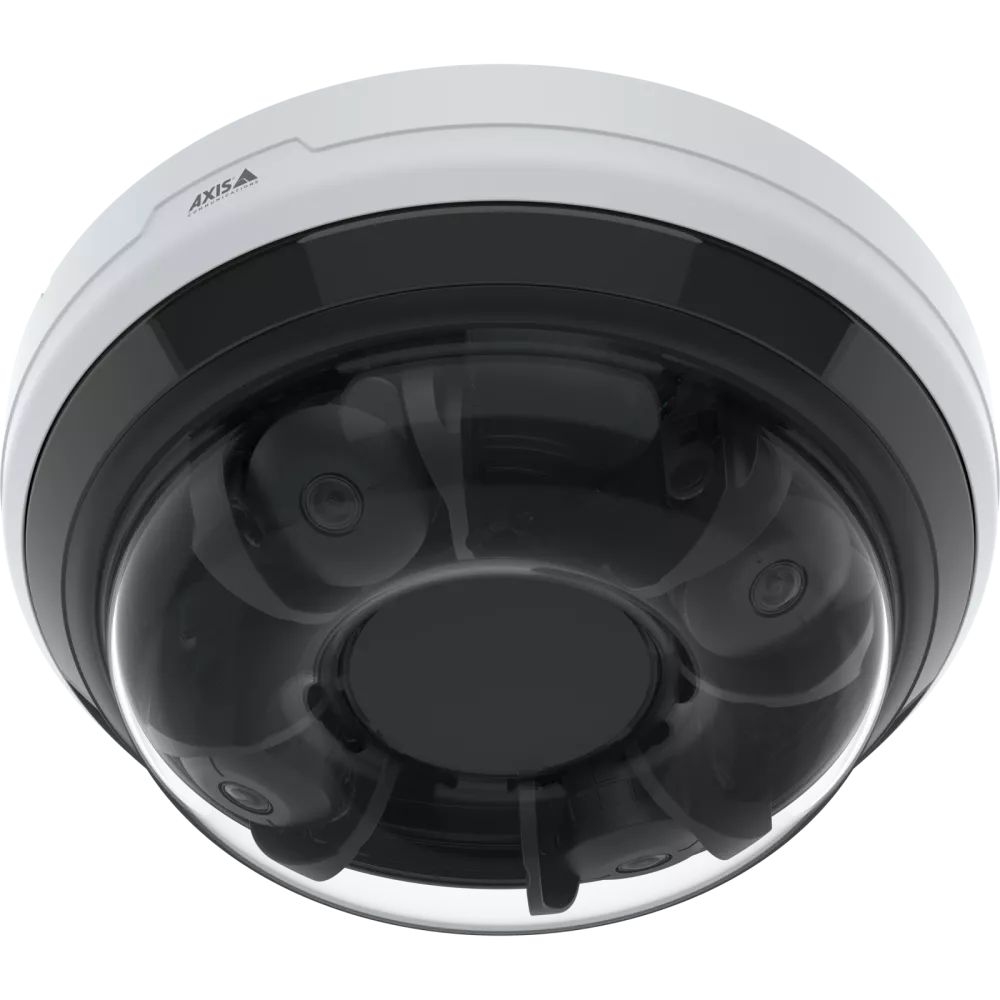
A multi-sensor (or multi-directional) camera packs two to four independent sensors under one dome, each with its own lens that you aim where you need it. Instead of one stretched hemisphere, you get four full-resolution views — 4K per head on current models — which means forensic-grade detail out to real distances, in every direction, from a single mounting point and a single cable.
This is the tool for building corners and perimeters, intersections and aisle crossings in warehouses, parking lots, campuses and loading docks. Models with per-head remote PTRZ — like the Hanwha PNM-C32083RVQ — let you re-aim each sensor from your desk, so coverage tweaks never require a ladder. On-board AI classifies people and vehicles per head, keeping alarms meaningful across all four views.
Which one does your space need?
| Your space | Best fit | Why |
|---|---|---|
| Open interior, ceiling 3–5 m (retail, lobby, cafeteria) | Fisheye | Full 360° from one central point; retroactive PTZ through recordings |
| Building corner / perimeter | Multi-sensor | Two walls + approaches at full resolution from one drop |
| Warehouse aisle intersections | Multi-sensor | Four aisles per mounting point; one VMS license instead of four |
| Parking lot pole | Multi-sensor | Long-range detail in several directions; IR models cover night |
| Elevator, small room | Compact fisheye | Whole space in one discreet unit |
| Large open floor with distant zones | Both | Fisheye for awareness + fixed/multi-sensor for detail at range |
Our picks across the three major brands
We carry panoramic lines from AXIS, Hanwha Vision and Pelco — here are the models our customers compare most:
Hanwha PNM-C32083RVQ 4K x 4, AI, IR Multi-directional outdoor camera
Pelco Sarix Multi Enhanced – 4-Head Multi-Directional Camera
The Pelco Sarix Multi Enhanced deserves a special note for its modular approach — configure it with three or four heads and mix lens options per head, so you only pay for the coverage you actually need. On the AXIS side, the dual-sensor P4707-PLVE covers two directions at 5 MP each from a single drop — the building-corner specialist — while the four-sensor AXIS P3737-PLE handles full four-way intersections, and Hanwha’s PNM-C line adds per-head AI object classification.
Getting it right the first time
Panoramic cameras reward planning: mounting height, ceiling type, night-time lighting and your VMS’s licensing model all change the answer. Send us a floor plan through our quote wizard and we’ll map out exactly which panoramic units — and how few of them — your space needs. Most customers are surprised by how much coverage one well-placed camera can deliver.

 USD $
USD $  CAD $
CAD $